Research · England · NHS data
Premature ejaculation help on the NHS: how it varies across England
Find your NHS area, compare it with the England average and choose where to start with ejaculation problems: a GP, an NHS sex therapist, or the stop-go and squeeze techniques the NHS describes for ejaculation control.
The NHS prescribes medicines for premature ejaculation more than 30 times as often in North East London as in Norfolk and Suffolk, according to new analysis of NHS data by Body Zen, a free app that guides men through the stop-start technique for premature ejaculation.
NHS prescribers in England issued 7,932 prescriptions for premature ejaculation in 2025, 22% more than the 6,523 issued in 2022, at a cost of £345,974. In the twelve months to July 2026, North East London issued 1,203, or 123.5 for every 100,000 men aged 18 and over; Norfolk and Suffolk issued 29, or 4.0. These figures cover NHS prescriptions only, not private or online ones.
“We looked at NHS prescribing for premature ejaculation across England, and the difference between areas surprised us. The NHS in North East London prescribes these medicines more than 30 times as often as the NHS in Norfolk and Suffolk, and local NHS guidance does not explain the gap. We believe men should be able to find the same help wherever they live.”
What help does the NHS offer for premature ejaculation?
The NHS offers three kinds of help for premature ejaculation: psychosexual counselling, techniques men practise themselves, and medicines (NHS: Ejaculation problems). In psychosexual counselling, a therapist works with a man, and his partner if he has one, on relationship issues and teaches the squeeze and stop-go techniques. Both techniques need regular practice. The stop-go technique is also known as the stop-start technique.
Doctors use four groups of medicines for premature ejaculation:
- Dapoxetine (Priligy): a tablet designed for premature ejaculation, taken 1 to 3 hours before sex. Each local NHS area decides whether to prescribe it.
- Anaesthetic creams and sprays containing lidocaine or prilocaine.
- SSRI antidepressants, such as paroxetine, sertraline and fluoxetine, and the antidepressant clomipramine.
- Sildenafil (Viagra): an erectile dysfunction medicine that research suggests may also help with premature ejaculation.
Dapoxetine is not suitable for every man, including some men with heart, kidney or liver problems, so a GP decides which medicine fits. Without a prescription, the NHS suggests masturbating an hour or two before sex or using a thick condom.
How do you get premature ejaculation treatment on the NHS?
Premature ejaculation treatment on the NHS starts with a GP. The NHS advises men with a persistent ejaculation problem to see their GP, who will discuss it, may examine them and may refer them to a specialist. The NHS also advises involving a partner as much as possible.
In the twelve months to July 2026, NHS prescribers in England issued 8,424 prescriptions for premature ejaculation: 8,405 for dapoxetine tablets (99.8%) and 19 for a lidocaine and prilocaine spray.
Can you see a sex therapist on the NHS?
NHS sex therapy is available in some parts of England, not all. The NHS says some integrated care boards provide a sex therapy service and that availability can vary widely depending on where you live.
Body Zen checked public NHS listings of psychosexual and sex therapy services for all 36 NHS areas in England. It found a listed service in 27 areas, could not find one in 5, and could not tell from the listings in 4. The five areas without a publicly listed service are Norfolk and Suffolk, Devon, Cornwall and the Isles of Scilly, Northamptonshire, and Herefordshire and Worcestershire.
Sixteen of the 27 listed services name premature ejaculation among the problems they treat. None clearly accepts self-referral, so men are usually referred by a GP. Waits can be long: University Hospitals Bristol reported an average wait of about 12 months in April 2025. The check covers public listings only; NHS teams whose service is missing can send details to hello@bodyzen.app.
Where in England does the NHS prescribe most for premature ejaculation?
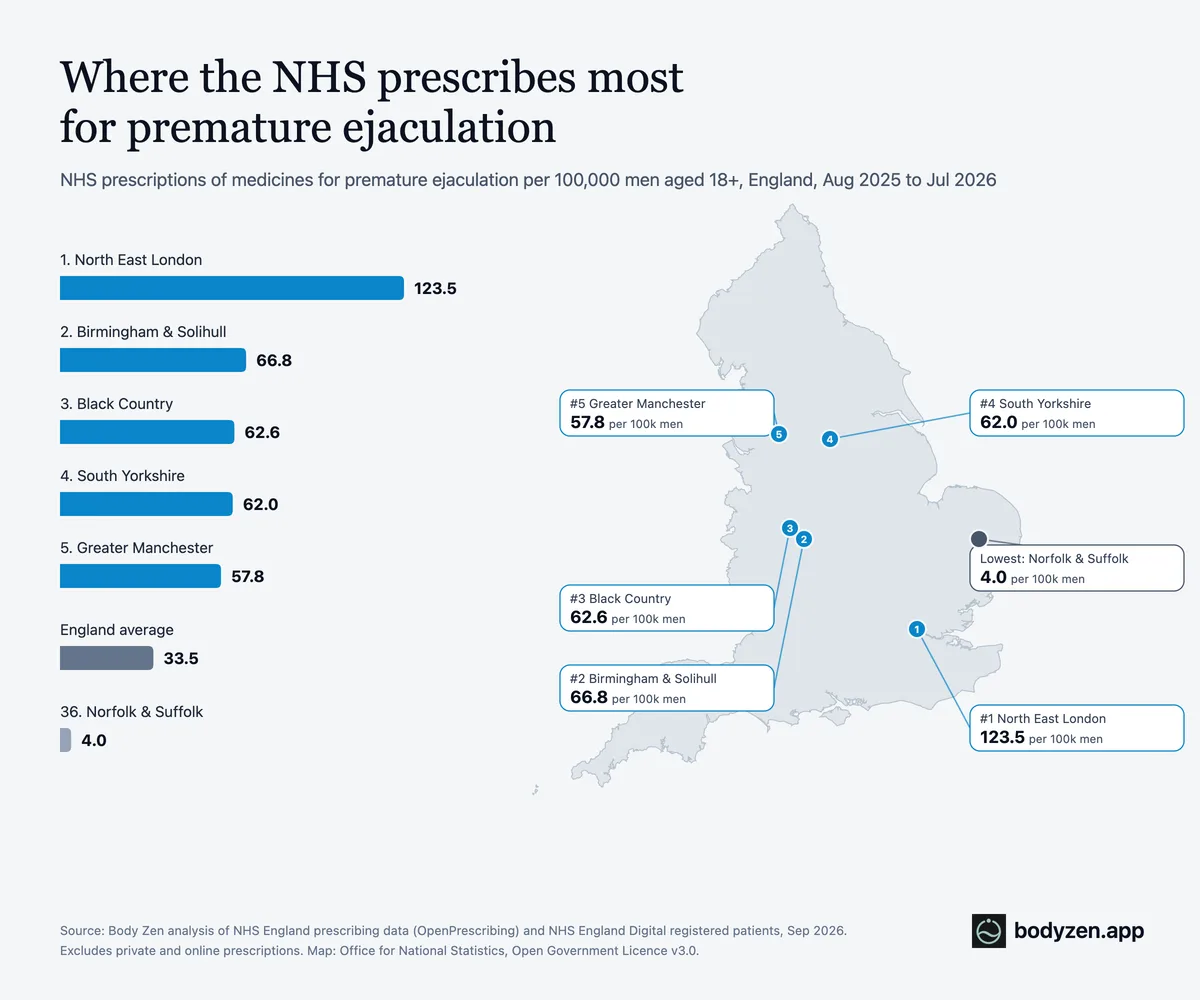
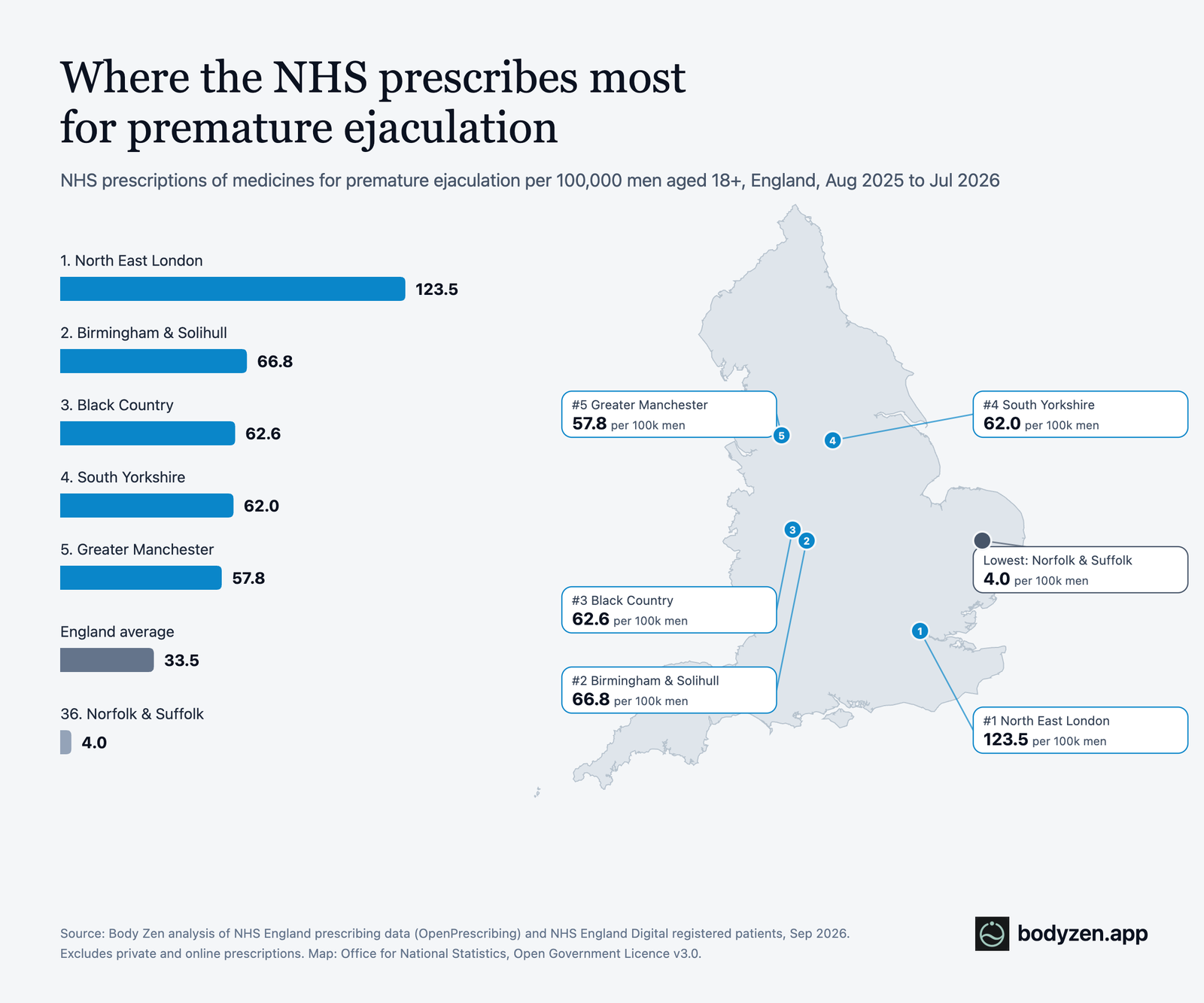
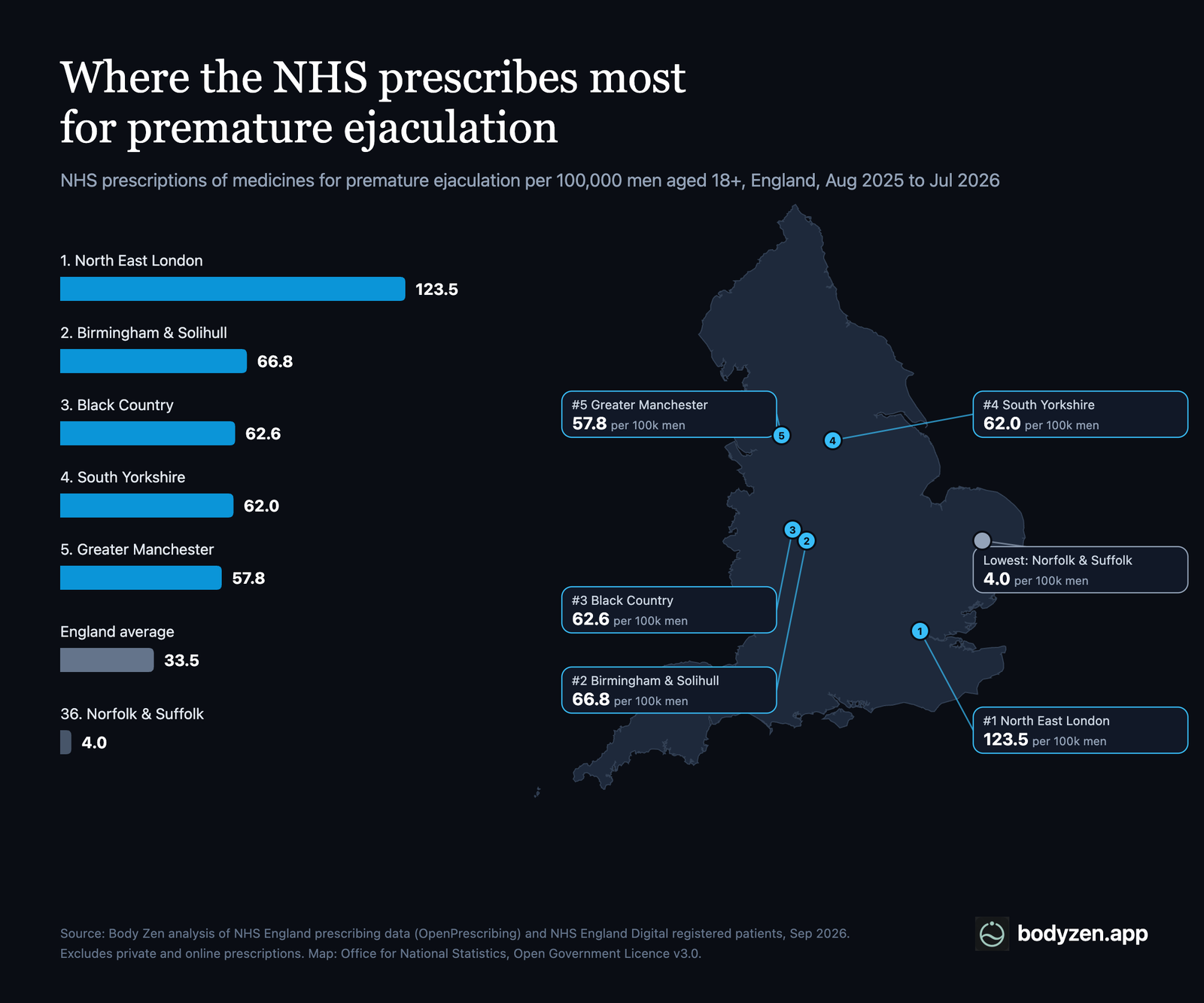
North East London prescribes most for premature ejaculation, at 123.5 prescriptions per 100,000 men in the year to July 2026: almost double the next area and 3.7 times the England average of 33.5. Birmingham and Solihull (66.8), the Black Country (62.6), South Yorkshire (62.0) and Greater Manchester (57.8) complete the top five.
Greater Manchester’s local formulary lists dapoxetine as “do not prescribe”, yet the area issued 748 prescriptions for premature ejaculation, the third-highest total in England.
Where does the NHS prescribe least for premature ejaculation?
Norfolk and Suffolk prescribes least for premature ejaculation: 29 prescriptions in the year to July 2026, or 4.0 per 100,000 men. Leicester, Leicestershire and Rutland (4.5), Dorset (4.8), Derby and Derbyshire (6.8) and Devon (6.9) complete the bottom five.
In Leicester, Leicestershire and Rutland, 14 of the 22 prescriptions were for the anaesthetic spray, more than in any other area. Norfolk and Waveney decided in 2013 that the cost of dapoxetine did not justify routine NHS use; the area is now drawing up a men’s health strategy.
NHS premature ejaculation prescribing in your area: all 36 areas
Across England’s 36 NHS areas, prescribing for premature ejaculation ranges from 4.0 to 123.5 prescriptions per 100,000 men, against an England average of 33.5. A man’s NHS area is set by the GP practice he is registered with.
| Rank | NHS area | Prescriptions | Per 100,000 men | Local NHS guidance on dapoxetine |
|---|---|---|---|---|
| 1 | North East London | 1,203 | 123.5 | Restricted |
| 2 | Birmingham and Solihull | 426 | 66.8 | Restricted |
| 3 | Black Country | 320 | 62.6 | Restricted |
| 4 | South Yorkshire | 377 | 62.0 | Allowed (in Barnsley only) |
| 5 | Greater Manchester | 748 | 57.8 | Restricted |
| 6 | Coventry and Warwickshire | 232 | 52.1 | Allowed |
| 7 | South West London | 349 | 51.0 | Not found online |
| 8 | West and North London | 966 | 49.9 | Not found online |
| 9 | Gloucestershire | 124 | 45.0 | Not found online |
| 10 | Cheshire and Merseyside | 466 | 41.5 | Allowed |
| 11 | Lancashire and South Cumbria | 258 | 34.6 | Restricted |
| 12 | Hampshire and Isle of Wight | 290 | 33.8 | Allowed |
| 13 | Somerset | 69 | 28.6 | Allowed |
| 14 | Bristol, North Somerset and South Gloucestershire | 125 | 28.4 | Not found online |
| 15 | Cornwall and the Isles of Scilly | 66 | 27.3 | Not found online |
| 16 | Surrey and Sussex | 327 | 26.5 | Not found online |
| 17 | Bath and North East Somerset, Swindon and Wiltshire | 105 | 26.5 | Restricted |
| 18 | Humber and North Yorkshire | 182 | 25.1 | Restricted |
| 19 | Northamptonshire | 81 | 24.4 | Not found online |
| 20 | Staffordshire and Stoke-on-Trent | 114 | 23.9 | Not found online |
| 21 | North East and North Cumbria | 308 | 23.8 | Not found online |
| 22 | Herefordshire and Worcestershire | 72 | 21.6 | Restricted |
| 23 | Shropshire, Telford and Wrekin | 44 | 20.8 | Not found online |
| 24 | Kent and Medway | 157 | 20.1 | Restricted |
| 25 | South East London | 161 | 19.4 | Restricted |
| 26 | Essex | 149 | 19.1 | Not found online |
| 27 | Thames Valley | 172 | 17.6 | Restricted |
| 28 | Nottingham and Nottinghamshire | 85 | 16.8 | Restricted |
| 29 | Central East | 176 | 12.8 | Not found online |
| 30 | Lincolnshire | 39 | 11.8 | Restricted |
| 31 | West Yorkshire | 99 | 9.4 | Restricted (in Leeds only) |
| 32 | Devon | 36 | 6.9 | Restricted |
| 33 | Derby and Derbyshire | 31 | 6.8 | Restricted |
| 34 | Dorset | 16 | 4.8 | Restricted |
| 35 | Leicester, Leicestershire and Rutland | 22 | 4.5 | Restricted |
| 36 | Norfolk and Suffolk | 29 | 4.0 | Restricted (in Norfolk and Waveney only) |
Twenty-four areas prescribe below the England average and 12 above it.
Do local NHS rules explain the difference in prescribing?
Local NHS rules do not explain the difference in prescribing on their own. A local formulary is the list of medicines an NHS area supports, and each area decides whether to include dapoxetine. Body Zen found a published formulary entry for dapoxetine in 24 of the 36 areas: 19 restrict it (non-formulary, red-listed or “do not prescribe”) and 5 allow it.
Four of the five highest-prescribing areas restrict dapoxetine, as do all five of the lowest. The data shows how often each area prescribes, not why.
“Premature ejaculation is nothing to be embarrassed about, and we want men to know that NHS help goes beyond a prescription. A GP can discuss medicines, refer men to a specialist, and explain techniques the NHS describes, such as stop-start, that men can practise privately.”
How NHS prescribing for premature ejaculation has changed since 2022
NHS prescriptions for premature ejaculation in England rose 22% between 2022 and 2025, while their cost rose 44%.
- Prescriptions in 2025
- 7,932
- 6,523 in 2022
- NHS cost in 2025
- £345,974
- £239,681 in 2022
- Gap between highest and lowest area
- 30×
- 123.5 vs 4.0 per 100,000 men
| Year | 2022 | 2023 | 2024 | 2025 |
|---|---|---|---|---|
| Prescriptions | 6,523 | 7,453 | 7,690 | 7,932 |
| NHS cost | £239,681 | £276,058 | £283,902 | £345,974 |
The average NHS cost per prescription rose from £36.74 in 2022 to £43.62 in 2025.
How common is premature ejaculation?
How common premature ejaculation is depends on how it is measured. In a survey of 12,133 men in the US, Germany and Italy, 22.7% reported low or no control over ejaculation that distressed them (Porst and colleagues, 2007). When 500 couples in five countries timed sex with a stopwatch, the median time to ejaculation was 5.4 minutes (Waldinger and colleagues, 2005).
The British Society for Sexual Medicine reports published estimates from 2% to 60% and links the spread to differences in the men studied, the methods and the definitions (2025 position statement). The NHS describes ejaculation problems as common in men.
What people in the UK search for when they need help
People in the UK search for the premature ejaculation tablet far more than for the techniques the NHS describes, even though the techniques need no prescription: about 9,800 Google searches a month for dapoxetine and Priligy, against about 430 for the stop-start and squeeze techniques.
| Searches for | Searches a month |
|---|---|
| The tablet (dapoxetine, Priligy) | 9,800 |
| The techniques (stop-start, squeeze) | 430 |
Over the past five years, England has had the highest share of Google searches for “premature ejaculation” of the four UK nations. On Google Trends’ scale, England scores 100, Northern Ireland 83, Wales 80 and Scotland 75.
How this analysis was done
Body Zen built this analysis from public NHS data and public NHS listings. The method below lets anyone check it.
- Prescriptions: NHS England primary-care prescribing data for medicines used for premature ejaculation (BNF section 7.4.6: dapoxetine tablets and lidocaine/prilocaine spray), from OpenPrescribing, for August 2025 to July 2026 and for the calendar years 2022 to 2025.
- Rates: prescription items per 100,000 men aged 18 and over registered with a GP, from NHS England Digital, September 2026, across 36 integrated care boards.
- Local rules: each area’s published local formulary entry for dapoxetine, found for 24 of the 36 areas.
- Therapy services: public NHS listings of psychosexual and sex therapy services for each area, checked on 5 October 2026.
- Searches: Google Ads monthly search volumes and Google Trends, via DataForSEO, 5 October 2026.
- Not included: private and online prescriptions, which NHS data does not show. Prescriptions are counted as items, not tablets or patients.
The data shows how much each NHS area prescribes and what each lists publicly, not why rates differ.
Data downloads and press contact
The full data and the map are free to reuse with the credit “Source: Body Zen analysis of NHS England data”, linking to bodyzen.app.
- Download the data for all 36 areas (CSV)
- Download the map and chart (PNG)
- Download the dark version (PNG)
Press contact: Nicola George, spokesperson for Body Zen, hello@bodyzen.app.